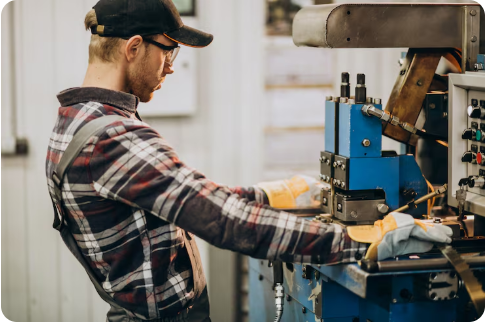
Sustained improvement in industrial manufacturing processes is essential for global competitiveness, cost management, and market agility.
Achieving excellence requires a multifaceted approach that moves beyond simple troubleshooting to encompass systemic changes in technology, quality control, and supply chain management.
By viewing the entire production lifecycle as an integrated system, companies can implement strategic enhancements that minimize waste, reduce variability, and ensure a consistently high-quality final product.
These comprehensive strategies are designed to transform an efficient operation into an optimized, future-ready enterprise.
Implementing Advanced Predictive Maintenance
Unplanned downtime is a major drain on manufacturing efficiency. A significant improvement comes from adopting predictive maintenance (PdM) techniques.
This involves installing Industrial Internet of Things (IIoT) sensors on critical machinery to monitor key performance indicators such as vibration, temperature, and current draw.
Maintenance teams use the resulting data and advanced analytics to predict component failure before it happens. This allows repairs to be scheduled during planned breaks, drastically increasing equipment uptime, reducing costly emergency repairs, and maintaining a smooth production flow.
Optimizing High-Precision Operations with Advanced Shaft Machining
In industries relying on complex rotating components, the efficiency and precision of the machining center directly influence product quality and assembly time.
Improving the process for shaft machining is vital. Industrial engineers focus on optimizing cutting tools, feed rates, and machine stability within the shaft machining process.
By using advanced computerized numerical control (CNC) equipment and rigorous quality checks, manufacturers can minimize cycle times and ensure extremely tight tolerances are met.
This precision in high-demand component production reduces downstream assembly errors and enhances the performance of the final product.
Streamlining Internal Logistics with Custom Foam Inserts
Efficient internal logistics are key to process improvement, particularly for the handling and transportation of delicate or high-value components.
A simple but highly effective solution is the implementation of custom foam inserts for tool organization and part transportation.
Utilizing custom foam inserts in storage drawers, tool cribs, and transport cases protects sensitive parts, prevents damage during movement, and significantly reduces the time operators spend searching for tools.
This improvement in workplace organization and component protection directly translates to fewer defects and faster changeover times.
Integrating Lean and Six Sigma Methodologies
Combining Lean manufacturing and Six Sigma provides a powerful framework for continuous process improvement.
Lean focuses on eliminating the seven types of waste (e.g., waiting, overproduction, defects), while Six Sigma focuses on reducing process variability and minimizing defects to near-perfect levels.
By implementing these methodologies, teams are trained to use data-driven techniques to identify root causes of inefficiency and consistently improve performance metrics. This dual focus ensures that the manufacturing process is not only fast but also highly consistent and quality-driven.
Enhancing Quality through Statistical Process Control (SPC)
Moving beyond simple end-of-line inspection, implementing Statistical Process Control (SPC) allows manufacturers to monitor and control quality during the actual production process. SPC involves sampling products at key stages and plotting measurements on control charts.
By observing trends and deviations, operators can make real-time adjustments to the process before defects are created. This preventative approach dramatically reduces scrap and rework rates, ensuring products meet specifications throughout the entire production run.